
Concrete RV Pads in Vineyard UT: What You Need to Know
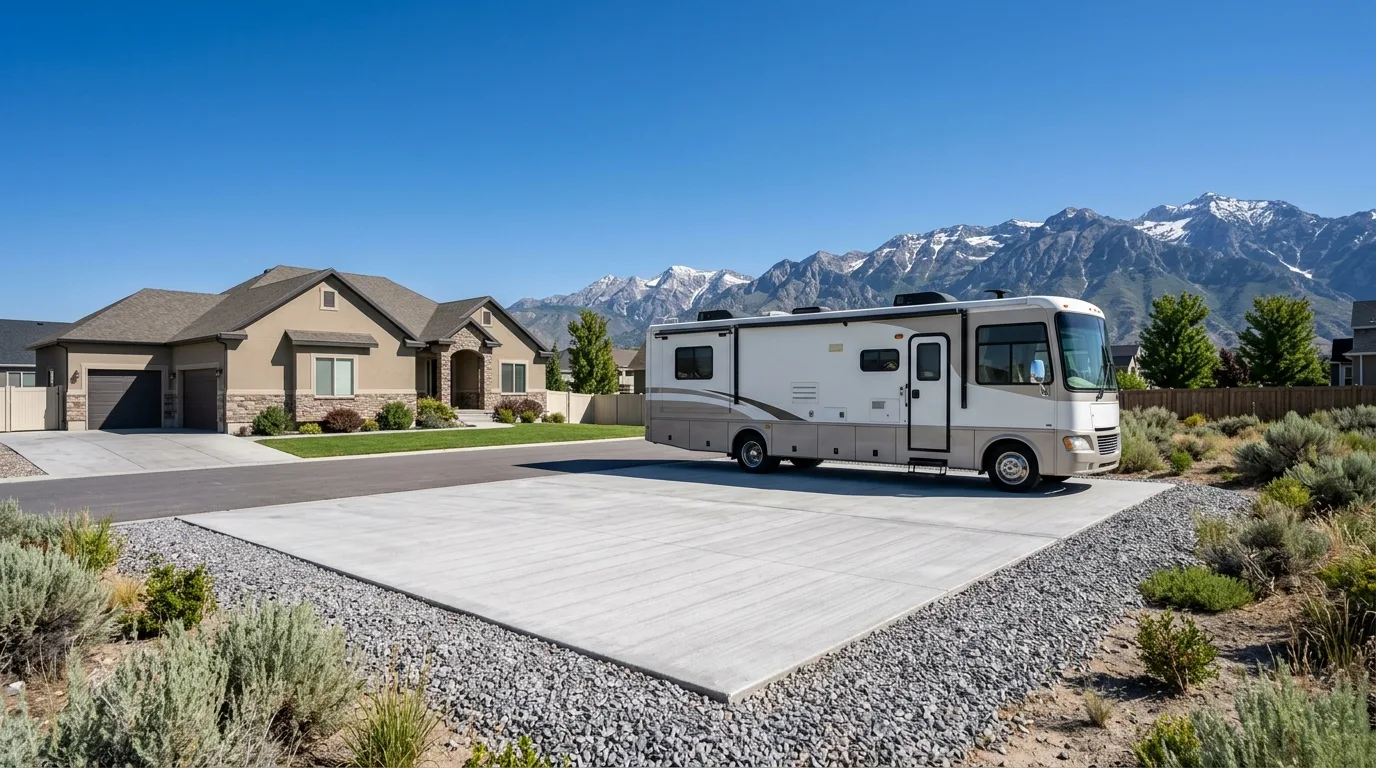
Vineyard, Utah is one of Utah County’s fastest-growing cities, and its newer subdivisions — particularly those with larger lots and three-car garages — increasingly include RV and boat storage as part of the home’s site plan. Concrete is the right material for RV storage pads in Vineyard for the same reason it outperforms asphalt for driveways: it holds up under heavy loads, survives the freeze-thaw cycling that destroys thinner slabs, and doesn’t soften in Vineyard’s hot July and August temperatures the way asphalt does. In this post, we cover what makes an RV pad different from a standard driveway, the correct specifications for Vineyard, and what you should expect to pay.
Free RV Pad Estimate in Vineyard
We spec RV pads for the actual load — not the minimum that looks adequate. Call for a free estimate.
Why RV Pads Need Different Specifications Than Driveways
A standard passenger vehicle weighs 3,000–5,000 lbs. A Class A motorhome weighs 20,000–30,000 lbs; a diesel pusher can exceed 40,000 lbs. A fifth wheel and half-ton truck combination typically exceeds 22,000 lbs. These loads are 5–8 times what a standard driveway is engineered for — and they’re applied through a relatively small contact area (the trailer tires), creating high point loads that quickly exceed the capacity of an under-specified slab.
The failure mode for under-spec’d RV pads is predictable: the slab cracks at the tire contact points within a few years of regular use, then water enters the cracks, freeze-thaw cycling widens them, and the sub-base begins to erode. What started as a cost-saving decision in the specification phase becomes a complete slab replacement within 5–8 years. The cost difference between a correctly specified RV pad and an under-spec’d one is typically $800–$1,500 on a standard 12-by-40-foot pad — a small fraction of the replacement cost.
Correct Specifications for an RV Pad in Vineyard
Slab thickness: Minimum 6 inches for all RV and heavy vehicle pads. Standard residential driveways are 4 inches; the 50% increase in thickness provides disproportionately more than 50% increase in load capacity because flexural strength scales with the square of the thickness.
Reinforcement: #4 (1/2-inch) rebar at 18-inch centers in both directions. Fiber mesh alone is not adequate for RV loads. The rebar schedule holds the slab together if cracking does occur and prevents the crack from progressing to a full structural failure.
Concrete mix: Minimum 4,000 PSI air-entrained concrete. The air entrainment is critical for Vineyard’s freeze-thaw cycle. Some contractors specify 4,500 PSI for heavy-duty pads, which improves both load capacity and freeze-thaw resistance.
Base preparation: Minimum 6 inches of compacted road base or crushed aggregate over stable subgrade. The base distributes the concentrated tire loads over a larger area of the subgrade soil — critical in Vineyard given the expansive clay content in Utah County soils. Heavy loads on a thin base over expansive clay produce rapid differential settlement.
Pad dimensions: Plan for at least 2 feet wider than your largest vehicle on each side, and at least 4 feet longer than the vehicle plus any tongue or hitch extension. Typical RV pads in Vineyard run 12–14 feet wide by 36–50 feet long.
RV Storage Concrete Pad in Vineyard
We'll measure your vehicle and spec the pad correctly — free site estimate for Vineyard homeowners.
Types of Concrete Finishes for RV Pads
Broom finish: Standard recommendation for RV pads. The texture provides traction for driving on and walking beside the vehicle. Easy to maintain and hoses clean easily.
Exposed aggregate: Higher friction coefficient than broom finish; good choice for areas that see snow or ice. Costs slightly more per square foot.
Stamped or decorative: Not recommended for the RV travel area because the stamp texture traps debris and is more difficult to clean under drivetrains. A decorative border around a plain or broom-finished center is a good compromise for aesthetics.
Practical Uses for Concrete Pads Beyond RV Storage
Boat trailer storage: Same load requirements as RV pads if the boat and trailer together exceed 10,000 lbs. Smaller boat trailers can use standard 4-inch slabs.
Commercial truck parking: Home-based business owners in Vineyard with pickup trucks, service vans, or heavy equipment trailers benefit from the same 6-inch specification. The additional investment protects the slab from the loads their vehicles actually impose.
Utility trailers and seasonal equipment: Standard driveways handle these loads adequately. If you’re adding a dedicated pad for boat plus RV plus equipment storage, the heavier spec makes sense for the whole area.
Tandem parking adjacent to garage: Some Vineyard homes use the side-yard area for a second parking pad. If this will be used for an RV, spec it to 6 inches even though it won’t see daily passenger vehicle traffic — the occasional heavy load events are what determine the required spec.
What an RV Pad Costs in Vineyard
With Utah County ready-mix at $125–$150 per yard and a 6-inch slab using 50% more concrete than a 4-inch slab, the material cost for an RV pad is meaningfully higher than a standard driveway. Labor is also slightly higher because the heavier concrete requires more careful finishing and the rebar placement takes more time than fiber mesh.
A 12-by-40-foot RV pad (480 square feet) at 6 inches thick typically costs $3,840–$5,760 in Vineyard — $8–$12 per square foot installed. Factors that affect cost include: site accessibility, amount of base material needed (higher if existing grade is soft or if the pad is in a low area), demolition of existing material, and any drainage structures. Stamped concrete additions to the borders add cost based on the decorative square footage.
Use our free cost calculator to estimate your RV pad project, or see our full walkways, steps & RV pads service page for more detail.
Frequently Asked Questions
How thick should a concrete RV pad be in Vineyard, Utah?
Minimum 6 inches for any RV or vehicle over 10,000 lbs. A standard 4-inch residential driveway is not adequate for motorhome or fifth-wheel loads. The additional thickness and rebar reinforcement prevent the cracking and settlement that occurs when heavy loads are applied to under-spec’d slabs.
Do I need a permit for an RV pad in Vineyard?
RV pads may require a permit depending on their location and scope. Check with the Vineyard Building Department at vineyard.cityinspect.com or call (801) 226-1929 before beginning work. Vineyard Concrete confirms permit requirements during every project estimate.
Can I use my existing driveway apron as an RV pad?
If the existing apron is 4 inches thick without heavy reinforcement, it can handle occasional use but will likely develop cracking under regular RV loads within a few years. A 6-inch reinforced extension next to or in front of the existing apron is usually the more cost-effective long-term solution.
Get a Free RV Pad Estimate in Vineyard, Utah
Vineyard Concrete specs RV pads for the actual vehicle load. Call (888) 376-0955.
Related: