
Vineyard's Soil and What It Means for Your Concrete
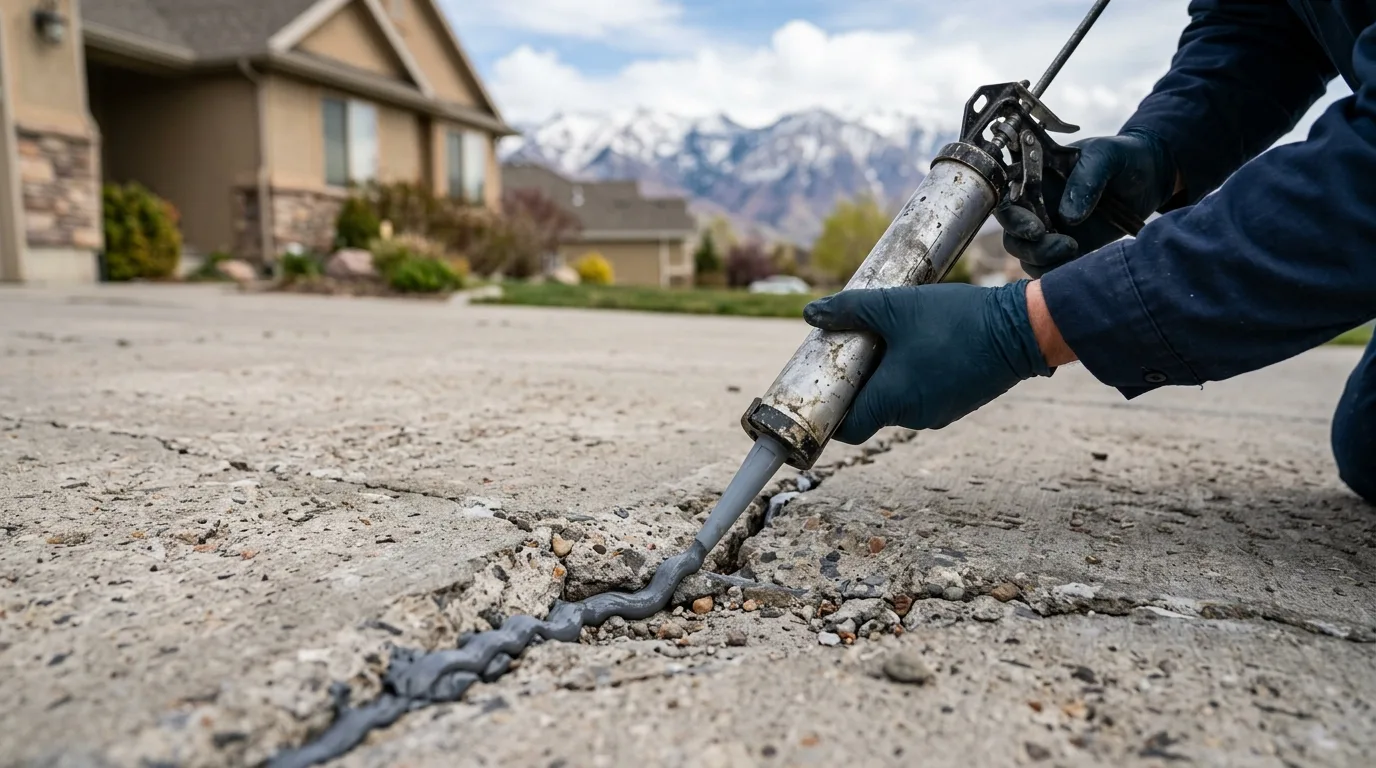
Most homeowners in Vineyard, Utah don’t think about soil until a slab starts cracking or a foundation wall develops a horizontal fracture. By then, the damage is already done — and the repair bill is far larger than the cost of understanding the soil before the concrete was poured. In this post, we cover what Vineyard’s soil profile actually contains, why expansive clay is the primary challenge for concrete work in Utah County, and what proper engineering looks like for slabs and foundations in this environment.
Concrete Built for Vineyard's Soil Conditions
We engineer every project for Utah County's expansive clay soils. Free estimates.
Why Vineyard’s Soil Is Different from Other Markets
Vineyard sits at 4,521 feet elevation on the ancient shoreline of Lake Bonneville — the massive prehistoric lake that once covered much of western Utah. As the lake receded, it left behind lake terrace deposits: calcareous alluvium derived from limestone and quartzite that was deposited in layers. These soils are classified by the USDA Natural Resources Conservation Service as the Vineyard series — deep, well-drained soils on lake terraces that include significant proportions of smectite-group clays in the upper horizons.
Smectite clays are classified as expansive soils. They have a lattice molecular structure that allows water molecules to enter between the clay platelets, causing the soil to swell when wet. When moisture is removed — during Vineyard’s dry late summers and early falls — those same clay platelets contract and the soil volume decreases. The seasonal moisture swings in Utah County are dramatic enough that this swell-shrink cycle can exert measurable upward and lateral pressure on concrete structures.
How Expansive Soil Damages Concrete in Vineyard
Driveways and patios: A flat concrete slab poured directly over native Vineyard soil without a compacted aggregate base will experience differential movement as the soil’s moisture content changes. In wet periods, sections of the slab rise; in dry periods, voids form beneath the slab as the soil contracts and pulls away from the concrete. This produces the familiar cracked, heaved, and rocking sections common in older Vineyard driveways. Homeowners throughout the Cascade and Hampton sub-neighborhoods of Waters Edge have experienced this pattern — it’s not random; it’s a predictable consequence of soil conditions.
Foundations: Expansive soil exerts lateral pressure on foundation walls as the soil swells toward any available surface. Horizontal cracks in basement walls — running parallel to the footing — are often a sign of lateral soil pressure exceeding the wall’s resistance. Proper foundation design in Vineyard includes adequate reinforcement for lateral loads, waterproofing to minimize moisture variation in the soil adjacent to the foundation, and in some cases, over-excavation and replacement with non-expansive material.
Foundation Issues in Vineyard? Get an Assessment
We understand Utah County's soil challenges — free concrete and foundation estimates.
The Collapsible Soil Risk Near Utah Lake
Properties near the Utah Lake shoreline — including the Holdaway Fields neighborhood and Lake Front community — face an additional soil challenge beyond expansive clay: collapsible soils. Young alluvial deposits near the lakeshore can compress suddenly when saturated, causing slabs to settle rapidly rather than heave gradually. This collapsible behavior is different from expansive soil movement and requires different engineering responses — typically pre-saturation of the subgrade before construction, or deep compaction.
The distinction matters because the surface symptoms look similar (cracked, settled concrete) but the solutions differ. A geotechnical report is the only reliable way to distinguish between expansive clay heave and collapsible soil settlement for properties near the Utah Lake shore in Vineyard or the nearby Lindon and Pleasant Grove waterfront areas.
Types of Concrete Projects Affected
Concrete driveways: Require a minimum 4-inch compacted aggregate base over the native Vineyard soil. The aggregate layer acts as a buffer that distributes load and provides drainage, isolating the slab from direct soil movement. Without it, the most expensive part of the driveway — the concrete itself — absorbs all the stress of the seasonal soil movement.
Concrete patios: Same base prep requirement as driveways. Patio slabs also benefit from proper control joint placement — the joints give the concrete a predetermined place to crack that doesn’t compromise the slab’s function.
Foundations and footings: Must be designed to extend below the frost line (approximately 24–30 inches in Vineyard) and sized for the specific bearing capacity of the soil at the excavation depth. Areas with known expansive clay require either over-excavation and replacement, or foundation designs with sufficient mass and reinforcement to resist soil movement.
What Good Concrete Work Looks Like in Vineyard’s Soil Conditions
Proper concrete practice for Vineyard’s soil profile includes: excavation and removal of the native soil to the required depth, placement and compaction of non-expansive aggregate base material (crushed limestone or road base, not local soil), installation of reinforcement per the structural spec, and a concrete mix with adequate strength (minimum 4,000 PSI) and air entrainment for the freeze-thaw environment. For foundation work near Utah Lake, a geotechnical investigation before excavation is standard practice.
Any contractor who doesn’t ask about your lot’s soil conditions — or who proposes to pour directly over the native grade without aggregate base — is not engineering your project for Vineyard’s specific conditions. For more on why soil conditions matter for foundation work specifically, read our post on new construction foundations in Utah County, and for the crack patterns these conditions produce, see why concrete cracks in Utah County.
Frequently Asked Questions
How do I know if my Vineyard property has expansive clay soil?
Most properties in Vineyard sit on lake terrace deposits with some expansive clay content. The highest risk areas are those with darker, heavier clay soils visible in excavations. A simple field test: take a sample of subgrade soil, add water, and observe swelling. A formal geotechnical investigation provides a more reliable assessment. For most residential flatwork in Vineyard, standard base prep specifications address the known risk adequately.
Does concrete sealing help with soil-related cracking?
Sealing reduces water infiltration into the concrete surface, which reduces freeze-thaw damage. However, sealing does not address soil movement beneath the slab. Cracks caused by expansive soil movement will recur regardless of surface sealing if the underlying soil issue isn’t corrected. The right solution for soil-movement cracking is base preparation, not just surface treatment.
Can I repair a driveway that’s heaved from expansive soil?
Yes — mudjacking or polyjacking can lift settled sections and fill voids beneath the slab. However, if the soil movement is ongoing, the repair may be temporary. Addressing the drainage conditions that cause moisture swings in the soil is often more durable than just lifting the slab. See our concrete repair service for a full assessment.
Concrete Engineered for Vineyard's Soil
Call Vineyard Concrete at (888) 376-0955 for a free estimate on any concrete project in Utah County.
Related: